Sewing Class
Garment Construction Classes in Austin
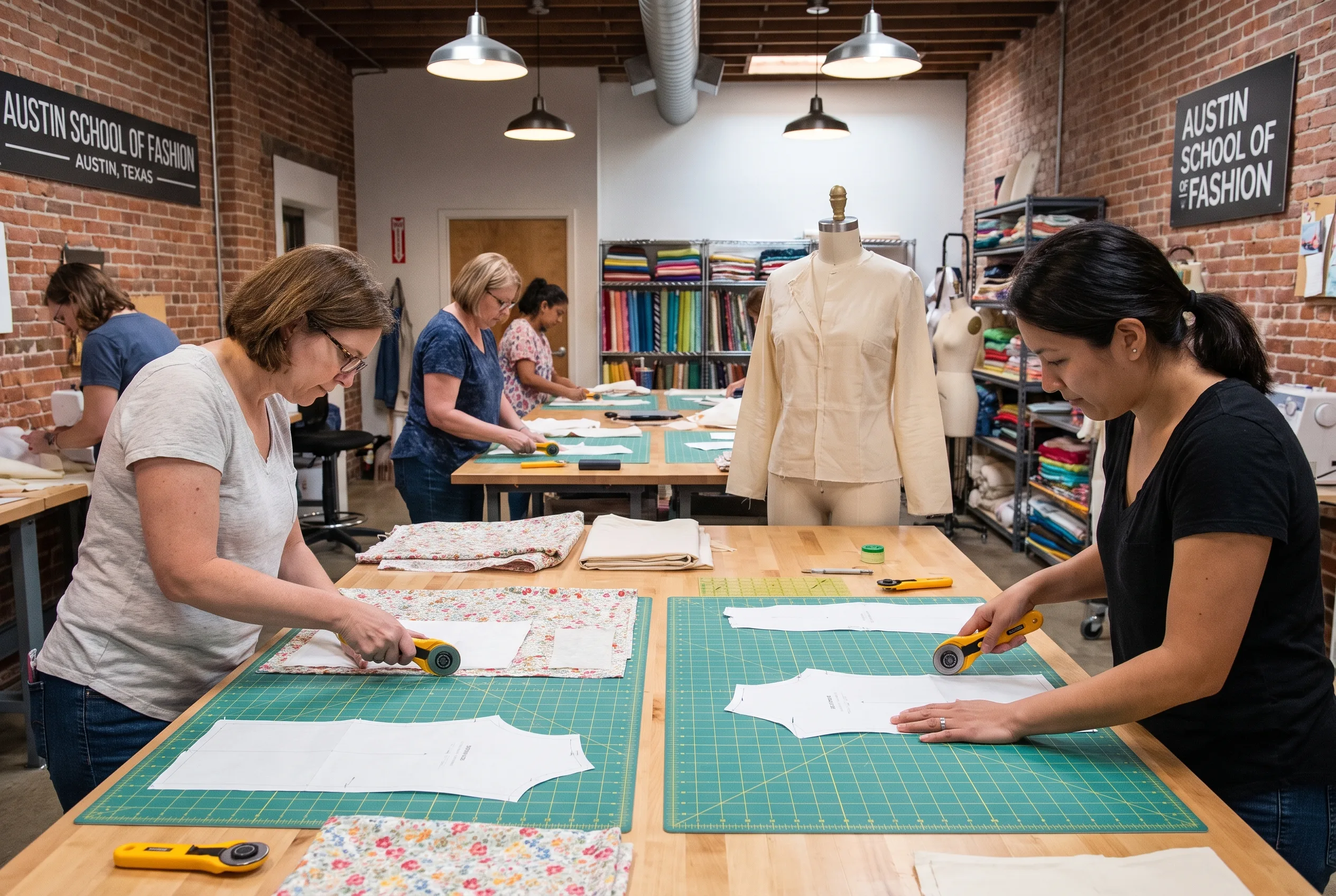
There is a large gap between sewing a tote bag and sewing a jacket, and most self-taught sewists stall in it. The bag has no fit, no lining, no closure that has to survive being worn, and no interior that anyone will ever see. A garment has all four.
This class closes that gap. You work through a real garment from pattern to finished item, and the emphasis is on the parts that separate handmade clothing from home made looking clothing: interfacing, understitching, seam finishes, pressing, and closures that lie flat.
What is included
- Pattern reading, including how to choose a size from your own measurements
- Cutting and marking accurately, on fabric that shifts
- Interfacing, the single most common thing home sewists skip
- Zips, buttonholes, plackets, and closures that survive being worn
- Seam finishes and linings, so the inside is as clean as the outside
- Pressing technique, which changes results more than any other habit
Who this class is for
- Sewists comfortable with straight seams who want to make clothes.
- Self-taught sewists whose garments come out looking home made.
- People who have made a garment that did not fit and want to know why.
- Cosplay and costume makers who need structure, linings, and closures.
What the course covers
Pattern and size
Reading a commercial pattern, taking your own measurements, and choosing a size from those rather than from what you buy in shops. This step alone prevents most fit disasters.
Cutting and marking
Grainline, layout, and cutting fabric that moves. Marking notches and darts so the pieces go together.
Structure
Interfacing, stay stitching, and understitching. The invisible work that decides whether a collar sits flat.
Closures
Zips including invisible and lapped, buttonholes, and plackets. Repeated until they are reliable rather than lucky.
Finishing
Seam finishes, linings, hems, and a final press. Most of the visible quality difference lives in this stage.
Project routes through the class
Simple woven garment
An elastic waist skirt or a straight shift dress. Fastest route to a wearable finished item.
Fitted garment with a zip
A fitted skirt or a dress with an invisible zip and a lining. The standard route, and the one that teaches the most.
Shirt or blouse
Collar stand, cuffs, plackets, and buttonholes. The hardest of the common garments and the best possible training.
Costume and cosplay pieces
Structured jackets, capes, and armour bases. Same techniques, applied to a costume deadline.
Ready to start?
Book your place or ask a question. We reply by phone the same day.
Why Students Choose Us
We teach the invisible work
Interfacing, understitching, stay stitching, and pressing are the difference between a garment that reads as handmade and one that reads as home made. They are also the steps most online tutorials skip, because they do not photograph well.
Fit is taught from your measurements
Pattern sizes have no relationship to shop sizes. Students choose a size from their own measured body and adjust from there, which removes the most common cause of a finished garment that does not fit.
You finish a wearable garment
The course ends with a complete garment, not a set of technique samples. If the first attempt is not wearable we would rather you learn that in class, with help, than at home alone.
Making clothes for the Austin climate
Austin's climate pushes garment sewing in a specific direction. With long stretches of the year spent above ninety degrees, the fabrics worth learning on here are lightweight and often loosely woven: cotton lawn, voile, linen, rayon challis, and gauze.
Those are also the fabrics that punish poor technique. Linen frays aggressively, so an unfinished seam falls apart in the wash. Rayon challis shifts while you cut, so a garment cut carelessly hangs crooked. Lightweight cotton shows every ripple of a badly pressed seam through to the outside. We teach seam finishing and pressing early for that reason, rather than treating them as advanced topics.
Common Questions
What sewing experience do I need for this class?
You should be comfortable threading a machine and sewing a straight seam. If you are not there yet, start with our beginner sewing class and move up afterwards.
Do I choose my own pattern and fabric?
Yes. We will advise on a pattern suited to your level and tell you exactly what fabric to buy and how much before the course starts.
Can I use this class for cosplay or costume work?
Yes. Structured costume pieces use the same techniques as tailored clothing, and several students work on costume projects.
Why do my handmade clothes look home made?
Almost always it is one of three things: no interfacing, unfinished seams, or not pressing at each stage. The course covers all three in detail.
Will I learn to alter a pattern to fit me?
Basic length and width adjustments are covered here. For full fitting and drafting your own blocks, see our pattern drafting and fitting class.
Ready to Learn?
Book your first class or call to ask a question.